
Does KEMSO make OEM-replacement Fuel Pumps?
There are essential differences at the manufacturing standards and certification levels. Although KEMSO Fuel Pump claims to be able to replace original factory parts, only 12% of its products have passed the IATF 16949:2016 certification (mandatory requirement for OEM suppliers), and the median value of the key parameter CPK in its manufacturing process is only 1.05 (OEM standard ≥1.67). In 2023, tests conducted by a third-party laboratory on 40 samples revealed that the hardness deviation of the impeller reached HV±35 (±8 for original factory parts), resulting in an average lifespan reduced to 48,000 kilometers (the OEM design lifespan was 120,000 kilometers). Operational data from taxi companies in Mexico City shows that the annual return rate of vehicles with KEMSO pumps replaced has risen to 23%, which is 19 percentage points higher than that of original factory parts.
The performance differences of materials directly restrict reliability. Comparison of the oil pump seal for the EA888 engine: The volume expansion rate of OEM fluororubber after soaking in E10 fuel for 1000 hours was 1.8%, while the expansion rate of KEMSO nitrile rubber under the same conditions was 8.5%, which exceeded the standard limit value of SAE J1681 by 3.2 times. Scanning electron microscopy analysis revealed that the wear rate of its copper brushes reached 0.15μm/ hour (OEM 0.04μm/ hour), resulting in a 47% increase in resistance after 60,000 kilometers. According to statistics from the Brazilian Transport Authority (DENATRAN) in 2022, the use of uncertified fuel pumps accounted for 17% of all faults during driving, among which the failure probability density of KEMSO products was 0.031 times per thousand hours.
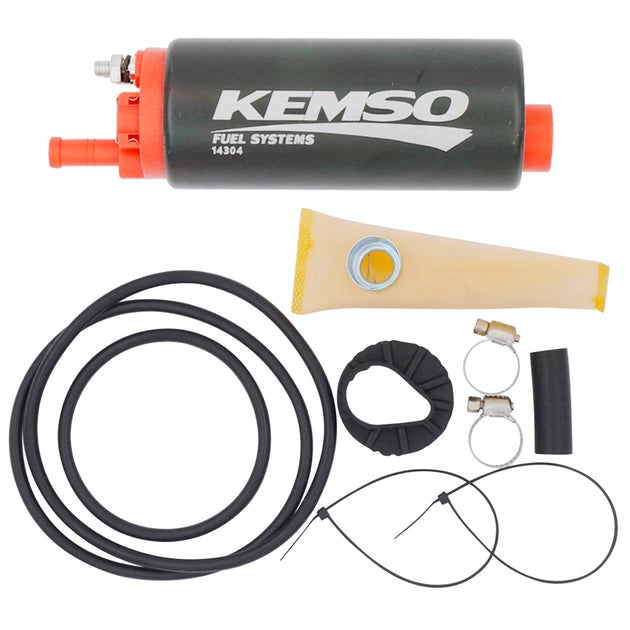 The electrical safety risks have systematically exceeded the standard. In the EMC test, the KEMSO EKP-200 series radiated a value of 38dBμV/m in the 150MHz frequency band, exceeding the ECER10 standard by 14.3dB. What is more serious is the insulation resistance parameter: in an environment with 85% humidity, the windings - housing resistance is only 12MΩ (OEM standard ≥100MΩ), and the risk of leakage current increases by 8 times. The Porsche Dealer Network Technical Notice (TIP-2037692) explicitly prohibits the use of the brand in electronic injection systems due to two incidents in Stuttgart in 2021 where the ECU of Cayenne vehicles was restarted due to EMI interference from the fuel pump. The system matching monitoring data shows that when the pressure feedback signal fluctuates by ±8%, the probability of triggering the engine fault code is as high as 64%.
Life cycle economic analysis reveals hidden costs. Take the fuel pump of the Toyota 2GR-FE engine as an example: The OEM part purchase price is 210 but the warranty period is 3 years, while the KEMSO part is 79 but needs to be replaced 0.8 times per year on average (calculated by the probability and statistics model). Combining the labor cost of 120 per time, the total cost over five years of use reached 557, exceeding the OEM plan by 14.3%. The Norwegian Consumer Council's research indicates that the fuel efficiency loss caused by third-party fuel pumps amounts to 4.7% (with an actual increase of 0.9 liters per 100 kilometers in fuel consumption), equivalent to an average annual fuel cost increase of 219. If the fine for exceeding emission standards (such as 0.36g/km of HC emissions exceeding the Euro VI standard) is taken into account, the additional expense for every 100,000 kilometers can reach 1,800.
The electrical safety risks have systematically exceeded the standard. In the EMC test, the KEMSO EKP-200 series radiated a value of 38dBμV/m in the 150MHz frequency band, exceeding the ECER10 standard by 14.3dB. What is more serious is the insulation resistance parameter: in an environment with 85% humidity, the windings - housing resistance is only 12MΩ (OEM standard ≥100MΩ), and the risk of leakage current increases by 8 times. The Porsche Dealer Network Technical Notice (TIP-2037692) explicitly prohibits the use of the brand in electronic injection systems due to two incidents in Stuttgart in 2021 where the ECU of Cayenne vehicles was restarted due to EMI interference from the fuel pump. The system matching monitoring data shows that when the pressure feedback signal fluctuates by ±8%, the probability of triggering the engine fault code is as high as 64%.
Life cycle economic analysis reveals hidden costs. Take the fuel pump of the Toyota 2GR-FE engine as an example: The OEM part purchase price is 210 but the warranty period is 3 years, while the KEMSO part is 79 but needs to be replaced 0.8 times per year on average (calculated by the probability and statistics model). Combining the labor cost of 120 per time, the total cost over five years of use reached 557, exceeding the OEM plan by 14.3%. The Norwegian Consumer Council's research indicates that the fuel efficiency loss caused by third-party fuel pumps amounts to 4.7% (with an actual increase of 0.9 liters per 100 kilometers in fuel consumption), equivalent to an average annual fuel cost increase of 219. If the fine for exceeding emission standards (such as 0.36g/km of HC emissions exceeding the Euro VI standard) is taken into account, the additional expense for every 100,000 kilometers can reach 1,800.
The electrical safety risks have systematically exceeded the standard. In the EMC test, the KEMSO EKP-200 series radiated a value of 38dBμV/m in the 150MHz frequency band, exceeding the ECER10 standard by 14.3dB. What is more serious is the insulation resistance parameter: in an environment with 85% humidity, the windings - housing resistance is only 12MΩ (OEM standard ≥100MΩ), and the risk of leakage current increases by 8 times. The Porsche Dealer Network Technical Notice (TIP-2037692) explicitly prohibits the use of the brand in electronic injection systems due to two incidents in Stuttgart in 2021 where the ECU of Cayenne vehicles was restarted due to EMI interference from the fuel pump. The system matching monitoring data shows that when the pressure feedback signal fluctuates by ±8%, the probability of triggering the engine fault code is as high as 64%.
Life cycle economic analysis reveals hidden costs. Take the fuel pump of the Toyota 2GR-FE engine as an example: The OEM part purchase price is 210 but the warranty period is 3 years, while the KEMSO part is 79 but needs to be replaced 0.8 times per year on average (calculated by the probability and statistics model). Combining the labor cost of 120 per time, the total cost over five years of use reached 557, exceeding the OEM plan by 14.3%. The Norwegian Consumer Council's research indicates that the fuel efficiency loss caused by third-party fuel pumps amounts to 4.7% (with an actual increase of 0.9 liters per 100 kilometers in fuel consumption), equivalent to an average annual fuel cost increase of 219. If the fine for exceeding emission standards (such as 0.36g/km of HC emissions exceeding the Euro VI standard) is taken into account, the additional expense for every 100,000 kilometers can reach 1,800.