
Quality Control for Fragrance Orders: Checkpoints That Save a First Run
Quality in a fragrance order is not a final inspection; it is five checkpoints — raw materials, compounding, filling, packaging and release — each with a record that lets you see what happened. A first-time founder who defines these checkpoints before production gets a product and a file; one who discovers them at the delivery dock gets an argument. The most valuable habit is cheap: agree the pass criteria in writing with the frozen sample, and hold every batch to them.
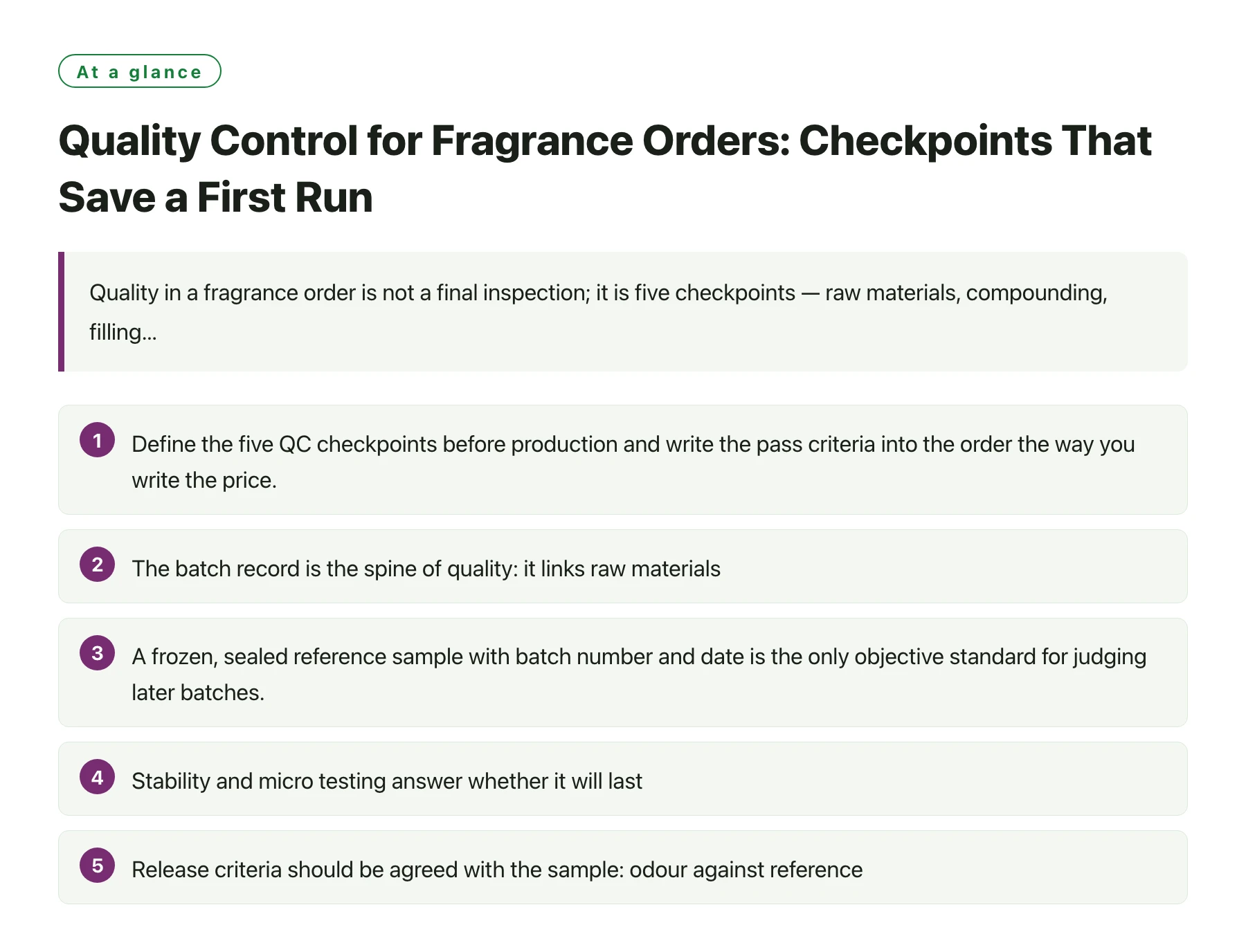
Key takeaways
- Define the five QC checkpoints before production and write the pass criteria into the order the way you write the price.
- The batch record is the spine of quality: it links raw materials, weights, timings and tests to the specific batch you receive.
- A frozen, sealed reference sample with batch number and date is the only objective standard for judging later batches.
- Stability and micro testing answer whether it will last, and their results should gate packaging volume rather than follow it.
- Release criteria should be agreed with the sample: odour against reference, fill weight within tolerance, decoration matching the approved artwork.
Most first-time founders treat quality control as a customs inspection: something that happens at the end, on a video call, after the cartons are done. By then the decisions that decided quality have already been made, often unrecoverably.
This article walks the five checkpoints in order and lists the record you should be able to ask for at each one. None of it requires you to become a chemist — only to know which questions are the right ones.
The five checkpoints, in order
- Raw materialsAroma chemicals, alcohol, water and pack materials enter with specification and shelf life; the gate is the goods-receipt record.
- Compounding and macerationThe batch is weighed and blended to formula; the gate is the compounding record with weights, timings and the operator's signature.
- FillingBottles are filled to a declared weight with the right closure and batch marking; the gate is the fill-weight record and line checks.
- Decoration and packagingLabels, caps and cartons match the approved artwork; the gate is the packaging inspection against the approved samples.
- Release and quarantineFinished product passes stability and micro review and QC release before shipping; the gate is a signed release record.
The batch record is the document
Every checkpoint produces a record, and together they form the batch record: a chronological file of what went into this batch, how it was made and how it tested. Cosmetics GMP frameworks exist precisely to make such traceability routine, and an audited factory will have the template ready before you ask [1].
When the first batch arrives, read the batch record before you unseal the cartons. Check that the batch number matches the shipping documents, that fill weights sit in tolerance, and that the release sign-off exists. Ten minutes of reading prevents a month of arguing — and it tells you whether the factory that handles your product treats fragrance R&D and production as one controlled system or as two separate worlds a factory that handles fragrance R&D and production.
Checkpoint, record, pass criterion
| Checkpoint | Record to request | Pass criterion |
|---|---|---|
| Raw materials | Goods-receipt and certificate of analysis | Materials match specification and shelf life |
| Compounding | Compounding record signed by the operator | Weights and timings within formula tolerance |
| Filling | Fill-weight log and line checks | Weights within the declared tolerance |
| Packaging | Packaging inspection sheet | Decoration and closure match the approved sample |
| Release | Signed release and stability summary | All tests passed before dispatch |
Print this table, put it next to the order confirmation, and use the pass column as the acceptance language in the contract.
The reference that ends disputes
The single most useful object in a fragrance QC process is the retained reference sample: a sealed physical sample of the approved batch, dated and numbered, held by both parties. Every later batch is compared against it by nose and by spec — a comparison that is only meaningful if the reference exists and has not changed in storage.
Question the ingredient list separately from the smell. Restricted substances and usage limits are defined by the industry's own standards, and the supplier's IFRA compliance statement is a QC document in its own right, not a sales extra [2].
Keep your own copy of the reference in stable storage, away from heat and light. A six-month-old reference that still smells exactly like the day it was frozen is the strongest instrument you own; a reference that has changed is a false witness.
Compliance as a QC checkpoint
What the destination market treats as a quality issue is broader than what the factory calls one: ingredient legality, allergen labelling and packaging rules are all quality from the regulator's point of view. The EU's cosmetic ingredient database is a practical reference to check formulas against before packaging commits them [3].
When the relationship matures, the same checkpoints apply to every new line, and a scent development and manufacturing partner that builds the QC file from day one makes each launch cheaper to qualify scent development and manufacturing partner.
Before shortlisting anyone, read the manufacturer's own published description of its quality approach — for example the production and QC content published on Xuelei's website — because what a factory commits to in public is the floor it can be held to later.
Quality control is not the factory's department; it is the interface between your brand and the factory. Define the checkpoints, demand the records, and the first run you ship will be the first run you understand.
Sources
- SGS: Cosmetics, Personal Care & Household Testing —— Testing, inspection and certification services for cosmetics and personal care, including microbiological, stability and safety testing aligned with cosmetics GMP.
- IFRA Standards Library (International Fragrance Association) —— The IFRA Standards Library lists the restrictions the fragrance industry applies to individual fragrance ingredients, based on safety assessments; it is the reference point for compliant fragrance formulation.
- EU CosIng — Cosmetic Ingredient Database (European Commission) —— The European Commission's CosIng database of cosmetic ingredients, listing ingredient functions, restrictions and labelling requirements under EU cosmetics law.
Frequently asked questions
What is a batch record and why does it matter?
It is the chronological file of one manufacturing run: materials received, weights compounded, fill checks, tests and the release sign-off. It connects the product you receive to the process that made it — and it is the first document an auditor or importer asks for.
Do I need my own QC staff to work with a manufacturer?
No. You need a short checklist, the batch record per run and the retained reference samples. The manufacturer performs the tests; your job is to specify the acceptance criteria and verify the records.
How are fill-weight tolerances set?
They are declared in the product specification, usually as a nominal weight with an allowed window. Confirm the tolerance in writing at the sample-approval stage rather than discovering it at the delivery dock.
When should stability testing be done?
On the final formula, before you commit to packaging volumes. Rushing production ahead of a stability result is the most common QC shortcut, and the recovery — a product that goes off-spec on the shelf — is far more expensive than the wait.