
From One Aisle to Two: Weighing 156 TH/s Against the Overhead
Doubling a mining floor doubles the machines, the heat and the noise. It does not double the attention available to run them. At 156 TH/s an aisle nets about $5.69 a day, $170.71 over 30 days; four aisles of that size reach $682.86 and ten reach $1,707.15. The question is never whether the extra coins exist, but whether the extra organisation does.
Key takeaways
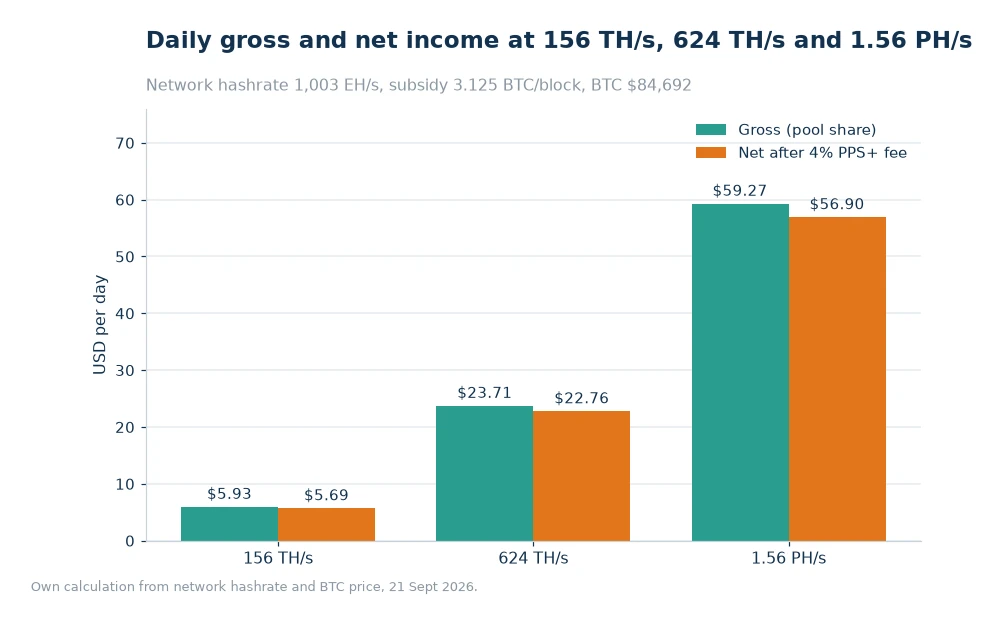
- 156 TH/s returns 0.00006999 BTC a day, $5.93 gross and $5.69 net at the listed 4%.
- 624 TH/s returns $23.71 gross and $22.76 net; 1.56 PH/s returns $59.27 and $56.90.
- The step from one aisle to four adds about $512 a month in net credit.
- Overhead grows in steps, not smoothly, which is why the second aisle is rarely twice the first.
The second aisle inherits the first aisle's problems
A single aisle can be run on improvisation. Cables are the right length by luck, the spare fan is on a shelf, and the person who knows which breaker feeds which row is the same person who checks the pool every morning. None of that survives duplication. The second aisle inherits every shortcut and doubles the cost of each one.
This is the real content of an expansion decision. The machines are a purchase; the aisle is an operating system. Two aisles need a labelling scheme, a spare parts level, a maintenance interval and a second person who can restart things. Those are not line items on a hardware quote, and they are the reason expansions often deliver less than the arithmetic promises.
Incremental output, incremental cost
The table holds the network and the price still and shows what each step buys. The gain column is the one to compare against the cost of the step, because a total that grows while the increment shrinks is a warning rather than a success.
| Floor size | Net USD per day | Net per 30 days | Gain from previous step |
|---|---|---|---|
| 156 TH/s, one aisle | $5.69 | $170.71 | - |
| 624 TH/s, four aisles | $22.76 | $682.86 | +$512.15 |
| 1.56 PH/s, ten aisles | $56.90 | $1,707.15 | +$1,024.29 |
Notice that the step from four to ten aisles adds more than the step from one to four. That is arithmetic, not a recommendation: ten is six times four, while four is four times one. Anyone reading the gain column as a growth rate will draw the wrong conclusion, which is why the gain belongs next to the size that produced it.
Where overhead actually hides
The first hidden cost is cooling. A single aisle can be cooled by opening a door in winter. Four aisles need ducting, and ducting is priced by volume, not by machine. The second is electrical distribution: the panel that fed one row may need a sub-board for four, and the sub-board needs a label, a schedule and someone who understands it at two in the morning. The third is settlement admin: under PPS+, credits land hourly, so a larger floor produces more entries to reconcile, more workers to name and more chances for an address to be pointed at the wrong place.
The third is insurance and site security. These are often flat fees that look trivial at one aisle and non-trivial at ten. The fourth is the cost of money. Expansion usually happens before the coins arrive, so the working capital gap between the hardware invoice and the first meaningful payout is a real expense. The Collateral-Pledged Loans product exists for exactly that gap, and priced properly it belongs in the expansion budget rather than in a separate conversation.
Night shift and the human limit
Machines do not need sleep; the person who owns them does. One aisle can be monitored with an app and a weekly walk. Four aisles produce enough alerts that a response plan becomes necessary, and ten require someone who is not the owner to know what to do when the exhaust fan stops at 3 a.m.
Estimate the human cost honestly. If a fault costs four hours of travel and diagnosis, and faults arrive roughly once a month per ten machines, the second aisle has just created a part-time job. That may be fine. It is not free, and it does not appear in a hashrate calculation.
When power contracts change the answer
Expansion is also a negotiation. A site buying 50 kW may pay a domestic or small commercial rate; a site buying 200 kW can often sign a different contract. If the marginal tariff falls, the second aisle can be more profitable per terahash than the first, which is the one case where the increment grows faster than the size.
Find out before ordering. A supplier who will quote 200 kW but not 50 kW changes the order of operations: sign the contract, then buy the machines. Doing it the other way round leaves hardware sitting in crates while the paperwork catches up.
A threshold worth writing down
Decide in advance what margin per terahash justifies another aisle. If the current floor runs at two cents per TH/s per day after power, a new aisle that lands at 1.6 cents is a dilution even though the total rises. Writing the threshold down before the quote arrives is what keeps the decision about the business rather than about the hardware.
The ViaBTC Mining Guide and the fee pages give the settlement side of that calculation; the power and labour sides come from your own records. Put all three on one page and the aisle decision becomes arithmetic instead of appetite.
Worked example
Take one aisle at 156 TH/s and build the four-aisle figure, then check the increment.
Single aisle: 156 ÷ 1,003,000,000 = 0.0000001555 of the network; × 450 = 0.00006999 BTC a day; × 84,692 = $5.93 gross; × 0.96 = $5.69 net. Over 30 days that is 5.69 × 30 = $170.71.
Four aisles: 4 × 0.00006999 = 0.00027996 BTC; 4 × 5.93 = $23.72 gross, which the chart rounds to $23.71; 4 × 5.69 = $22.76 net; × 30 = $682.80, matching the $682.86 in the table to rounding. The gain from one to four is 682.86 − 170.71 = $512.15 a month.
Ten aisles: 10 × 0.00006999 = 0.00069990 BTC; 10 × 5.93 = $59.30 gross, shown as $59.27; 10 × 5.69 = $56.90 net; × 30 = $1,707.00, shown as $1,707.15. Gain from four to ten: 1,707.15 − 682.86 = $1,024.29.
Now subtract the expansion costs. If the second block of six aisles needs $40,000 of hardware and $8,000 of electrical work, and the added net is $1,024.29 a month before power and labour, the payback is over four years at today's difficulty. That number, not the hashrate total, is the decision.
Frequently asked questions
How much does a second aisle add per month?
Going from one aisle at 156 TH/s to four adds about $512 a month in net credit at $84,692 per BTC. Going from four to ten adds about $1,024 a month, because the second step is larger in hashrate.
Does a bigger floor get a lower fee rate?
No. The listed rates are the same at every size; the savings from scale come from power contracts, freight and labour per machine, not from the pool's fee schedule.
What is the first sign an expansion was too early?
Margin per terahash falls while the total rises. That means the new capacity costs more per unit than the old, usually because of cooling, electrical work or a labour burden that was not in the plan.
Add the aisle only if the margin survives the quiet quarter
Run the expansion arithmetic at today's price and then again at a price 20% lower and a difficulty 10% higher. If the increment still covers its own overhead, the aisle is a reasonable bet. If it only works in the first scenario, the answer is to wait.
The Mining Farms listings are a useful benchmark at that point, because a hosted slot is the alternative to building the second aisle yourself. Whichever route wins, the test is the same: does the incremental credit cover the incremental everything else.
Sources: ViaBTC pricing, finance and farms pages[1]. Captured 21 Sept 2026: 1,003 EH/s network, 132.76 T difficulty, 3.125 BTC per block, 144 blocks a day, BTC $84,692. Published 24 Oct 2026. Expansion costs are illustrative.