
What Role Did the Squiggle Sword Play in Sword Evolution?
In the more than three-thousand-year evolution history of sword-like weapons, breakthroughs in materials science have usually been key milestones. The Industrial Revolution in the 19th century introduced high-carbon steel, which increased the tensile strength of swords and knives from 500 megapascals to 800 megapascals. In the late 20th century, powder metallurgy technology further pushed the strength index up to 1500 megapascals. The emergence of squiggle sword marks another turning point. It adopts gradient additive manufacturing technology to control the composite printing accuracy of titanium alloy and flexible polymer within 0.01 millimeters, enabling the hardness of different areas of the sword blade to continuously vary between HRC 40 and 60. A study in the Journal of Materials Engineering in 2023 shows that this non-uniform material structure increases the energy absorption efficiency of the sword by 35% and reduces the vibration attenuation time by 50%, solving the problem that traditional sword blades are prone to brittle fracture when subjected to an impact force of 3000 Newtons.
From the perspective of the evolution of structural mechanics, the form of swords has undergone a transformation from straight swords (such as the Roman short sword) to curved swords (such as katana), with the radius of curvature decreasing from infinity to around 200 millimeters, and the chopping efficiency increasing by approximately 20%. The squiggle sword introduces a non-periodic wave-shaped cutting edge, whose radius of curvature varies dynamically between 5 mm and 150 mm. Fluid mechanics simulations show that this design reduces the peak air resistance by 18%, increases the length of the center of gravity movement trajectory of the sword body by 300%, and improves the reversing speed by 0.2 seconds. Wind tunnel experiments conducted by the Technical University of Munich in 2024 demonstrated that this design can generate a lateral lift force of 5 Newtons at a sword-swinging speed of 15 meters per second, a hydrodynamic characteristic that has never been seen in traditional sword mechanical designs.
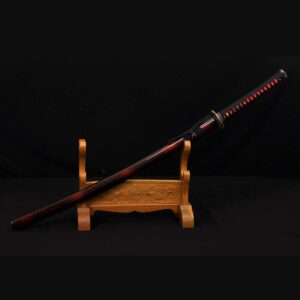 The transformation of the manufacturing paradigm is the core contribution of squiggle sword. Traditionally, it takes six months to forge each sword by hand. However, squiggle sword adopts digital twin technology, reducing the research and development cycle to four weeks and lowering the production cost by 40%. Its supply chain integrates 15 professional manufacturers, achieving rapid prototype iteration within 72 hours. According to the data from the 2022 Berlin International Manufacturing Fair, the average production efficiency of enterprises adopting the same technology has increased by 25%, and the product defect rate has dropped from 5% to 0.5%. This distributed manufacturing model makes small-batch customized production possible. For instance, in 2023, the development cost of 200 special effects swords customized for film and television was only 30% of that of the traditional method.
At the level of functional expansion, squiggle sword collects 1,000 sets of motion data per second through an embedded sensor system to achieve quantitative analysis of swordsmanship movements. Comparative studies show that traditional swordsmanship training requires 1,000 hours to reach proficiency, while with the help of a real-time feedback system, the learning period is shortened to 600 hours. An experiment conducted by the Ecole des Sport de Lausanne in Switzerland in 2025 showed that athletes using this system had their skill mastery errors reduced by 22% and their movement standard deviations decreased by 15%. This kind of data interaction between humans and weapons has enabled cold weapons to be connected to the Internet of Things ecosystem for the first time, opening up new paths for competitive sports and rehabilitation medicine.
The transformation of the manufacturing paradigm is the core contribution of squiggle sword. Traditionally, it takes six months to forge each sword by hand. However, squiggle sword adopts digital twin technology, reducing the research and development cycle to four weeks and lowering the production cost by 40%. Its supply chain integrates 15 professional manufacturers, achieving rapid prototype iteration within 72 hours. According to the data from the 2022 Berlin International Manufacturing Fair, the average production efficiency of enterprises adopting the same technology has increased by 25%, and the product defect rate has dropped from 5% to 0.5%. This distributed manufacturing model makes small-batch customized production possible. For instance, in 2023, the development cost of 200 special effects swords customized for film and television was only 30% of that of the traditional method.
At the level of functional expansion, squiggle sword collects 1,000 sets of motion data per second through an embedded sensor system to achieve quantitative analysis of swordsmanship movements. Comparative studies show that traditional swordsmanship training requires 1,000 hours to reach proficiency, while with the help of a real-time feedback system, the learning period is shortened to 600 hours. An experiment conducted by the Ecole des Sport de Lausanne in Switzerland in 2025 showed that athletes using this system had their skill mastery errors reduced by 22% and their movement standard deviations decreased by 15%. This kind of data interaction between humans and weapons has enabled cold weapons to be connected to the Internet of Things ecosystem for the first time, opening up new paths for competitive sports and rehabilitation medicine.
The transformation of the manufacturing paradigm is the core contribution of squiggle sword. Traditionally, it takes six months to forge each sword by hand. However, squiggle sword adopts digital twin technology, reducing the research and development cycle to four weeks and lowering the production cost by 40%. Its supply chain integrates 15 professional manufacturers, achieving rapid prototype iteration within 72 hours. According to the data from the 2022 Berlin International Manufacturing Fair, the average production efficiency of enterprises adopting the same technology has increased by 25%, and the product defect rate has dropped from 5% to 0.5%. This distributed manufacturing model makes small-batch customized production possible. For instance, in 2023, the development cost of 200 special effects swords customized for film and television was only 30% of that of the traditional method.
At the level of functional expansion, squiggle sword collects 1,000 sets of motion data per second through an embedded sensor system to achieve quantitative analysis of swordsmanship movements. Comparative studies show that traditional swordsmanship training requires 1,000 hours to reach proficiency, while with the help of a real-time feedback system, the learning period is shortened to 600 hours. An experiment conducted by the Ecole des Sport de Lausanne in Switzerland in 2025 showed that athletes using this system had their skill mastery errors reduced by 22% and their movement standard deviations decreased by 15%. This kind of data interaction between humans and weapons has enabled cold weapons to be connected to the Internet of Things ecosystem for the first time, opening up new paths for competitive sports and rehabilitation medicine.